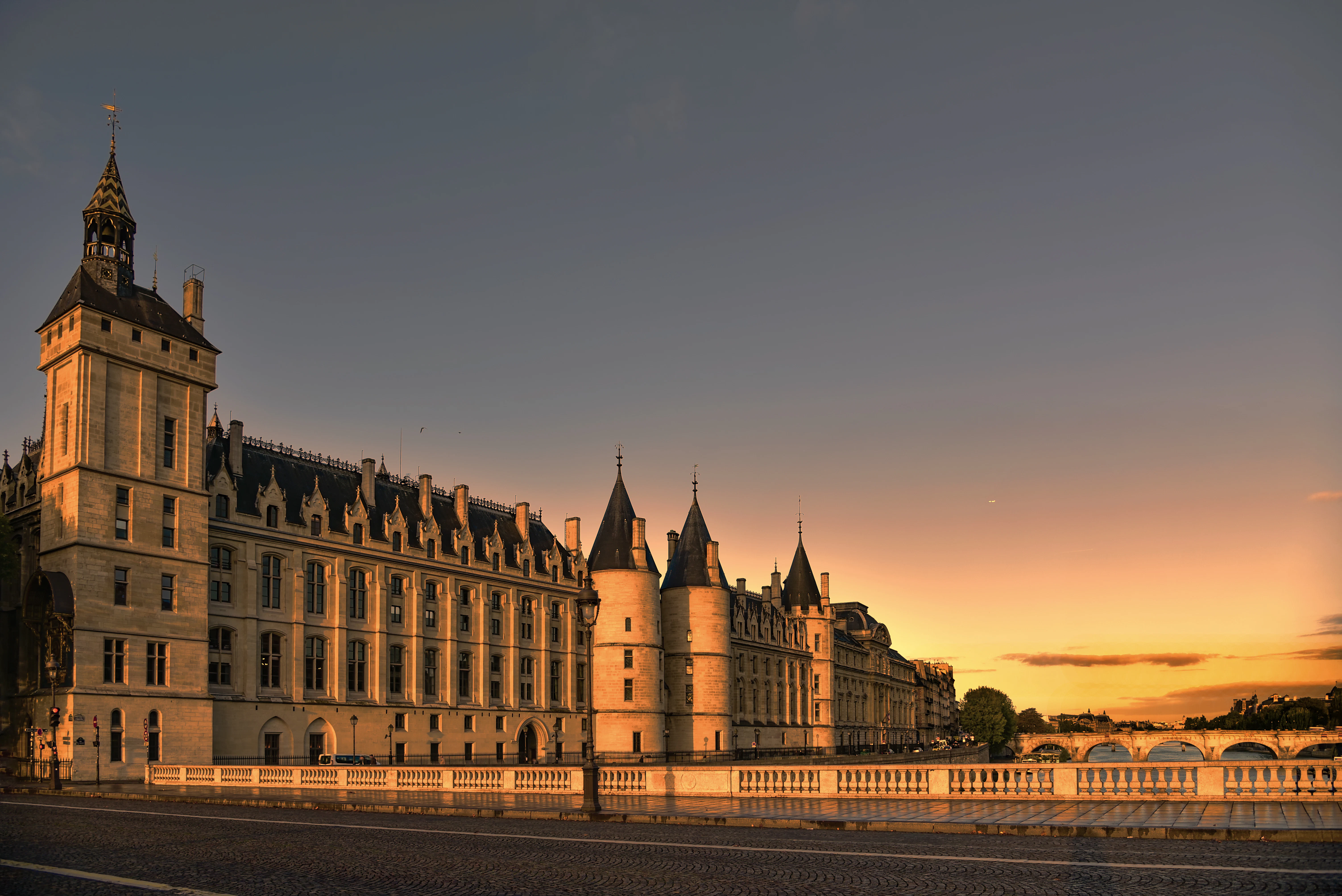
Visit a former royal palace and revolutionary prison on the Île de la Cité. See Marie Antoinette's cell and learn about its role during the French Revolution.
Visit Info & Tips
Steeped in centuries of French history, the Conciergerie stands as a poignant testament to Paris's tumultuous past. Once a royal palace, then a revolutionary prison, and now a revered national monument, its ancient walls whisper tales of kings, queens, and commoners who walked its hallowed halls. Located on the Île de la Cité, this iconic Gothic edifice offers visitors a chilling yet captivating journey through one of the most significant periods in French history: the French Revolution. Today, the Conciergerie acts as a powerful reminder of the Reign of Terror, when scores of perceived enemies of the Revolution were imprisoned here before facing the revolutionary tribunal and, oftentimes, the guillotine. The most famous inmate, of course, was Queen Marie Antoinette, whose reconstructed cell provides a haunting glimpse into her final days. As you wander through the vast, vaulted Gothic halls, such as the impressive Salle des Gens d'Armes (Hall of the Guards), you can almost hear the echoes of the past, imagining the daily lives of both prisoners and their guards. Beyond its somber history as a prison, the Conciergerie also showcases remnants of its grander past as a royal residence. The magnificent medieval architecture, particularly evident in the towers like the Tour de l'Horloge with its stunning clock, speaks to its early role as part of the Palais de la Cité, the primary residence of the Kings of France from the 10th to the 14th centuries. The building's transformation from a palace of power and luxury to a place of confinement and justice underscores the dramatic shifts in French society, making it a crucial site for understanding the evolution of the French state and its people. A visit to the Conciergerie is not merely a historical tour; it is an immersive experience. The innovative HistoPad tablet, offered with admission, brings the past to life with augmented reality, allowing you to visualize rooms as they appeared centuries ago and interact with digital reconstructions. This modern touch bridges the gap between today's visitor and the profound historical events that transpired here, offering a deeper, more engaging understanding of the lives and fates of those who passed through its gates. The Conciergerie is a place of profound reflection, inviting visitors to ponder themes of justice, power, and human resilience.





Compare & Save
-
Conciergerie Priority EntranceTickets
 TiqetsFrom€0
 -
Notre Dame Cathedral Of Paris Ile De La Cite Small Group Guided Walking TourToursTiqetsFrom€0
-
Paris in a Day: Louvre, Notre-Dame, Sainte-Chapelle & ConciergerieTours
 HeadOutFrom€188
 -
Sainte Chapelle Conciergerie Priority EntranceTicketsTiqetsFrom€0
-
Sainte-Chapelle & Conciergerie + Musée de l'Armée - Les InvalidesBundlesTiqetsFrom€28
Practical Info
About Conciergerie
Originally known as the Palais de la Cité, the Conciergerie served as the seat of French royal power from the 10th to the 14th century. It was the primary residence of kings such as Saint Louis and Philip the Fair, who transformed the site into a masterpiece of Gothic civil architecture. When Charles V moved the royal court to the Louvre in 1358, the building was left to the 'Concierge'—the high-ranking official responsible for maintaining order and managing the administration of justice. Its monumental Gothic interiors remain some of the finest in the world. The Salle des Gens d'Armes (Hall of the Men-at-Arms), built under Philip the Fair around 1300, is a vast vaulted space that once served as the magnificent dining hall for the king's 2,000 royal staff members. Nearby, the Salle des Gardes served as the king's reception room and remains an architectural marvel of rib-vaulted construction. From 1391, the complex began its transition into a prison, eventually becoming the most dreaded detention center in France. During the Reign of Terror (1793–1794), it earned the nickname 'the antechamber of the guillotine.' More than 2,700 prisoners were held here before their executions, including Danton, Robespierre, and most famously, Queen Marie Antoinette, whose former cell has since been converted into a memorial chapel. Today, the site stands as a dual testament to medieval grandeur and revolutionary turmoil. Visitors can walk through the dark corridors of the prison while comparing them to the majestic riverside towers, including the Tour de l'Horloge, which houses Paris's first public clock. This unique architectural mix makes the Conciergerie one of the most significant historical landmarks in the heart of Paris.
What to See
Conciergerie
Salle des Gens d'Armes (Hall of the Guards)
Marie Antoinette's Cell
The Courtyard (Cour des Femmes)
The Prison Cells
Tour de l'Horloge (Clock Tower)
The Revolutionary Tribunal Reconstructions
FAQ
History
<p>The story of the Conciergerie begins long before the Revolution. It was originally part of the Palais de la Cité, the principal residence of the Kings of France from the 10th to the 14th century. King Philip IV, also known as Philip the Fair, significantly rebuilt and expanded the palace in the early 14th century, establishing the impressive Gothic structure we see today, including the Salle des Gens d'Armes and the kitchen. However, by the late 14th century, the Kings of France began to abandon the Cité for other residences like the Louvre and Vincennes, and the palace was converted into administrative offices and a prison.</p><p><strong>Key Dates:</strong></p><ul><li><strong>10th-14th Century:</strong> Becomes the primary royal residence for French Kings.</li><li><strong>Early 14th Century:</strong> King Philip IV undertakes major construction, creating the vast Gothic halls.</li><li><strong>Late 14th Century:</strong> The royal family moves out; parts of the palace are converted into a prison and administrative center. The name 'Conciergerie' derives from the 'Concierge,' a high-ranking official appointed by the king to maintain order and administer justice within the palace.</li><li><strong>17th-18th Century:</strong> Becomes notorious as a state prison.</li><li><strong>1793-1794:</strong> During the Reign of Terror, it serves as the main antechamber to the guillotine, holding thousands of prisoners.</li><li><strong>1815-1830:</strong> Marie Antoinette's cell is converted into an expiatory chapel during the Bourbon Restoration.</li><li><strong>1914:</strong> Classified as a historical monument and opened to the public.</li></ul><p>During the French Revolution's Reign of Terror (1793-1794), the Conciergerie earned its chilling moniker as the 'Antechamber to the Guillotine.' Over 2,700 individuals were imprisoned here, awaiting judgment by the Revolutionary Tribunal. Notable figures like Georges Danton, Maximilien Robespierre, and, most famously, Queen Marie Antoinette, spent their final days within its walls. The conditions were harsh, with prisoners often packed into communal cells, while wealthier inmates could pay for slightly better accommodations.</p><p>One of the most poignant anecdotes involves Marie Antoinette herself. Imprisoned in August 1793, she was confined to a small, often damp cell, constantly under surveillance. Her trial, a swift and brutal affair, lasted only two days before she was condemned to death. On October 16, 1793, she was taken from the Conciergerie to the Place de la Révolution (now Place de la Concorde) where she was guillotined. Her final journey from her cell through the Palais de la Justice courtyard is meticulously recreated for visitors using the HistoPad, allowing a powerful connection to this tragic moment.</p>
Save more with a Paris Pass that includes Conciergerie
Bundle multiple top attractions, skip lines and pay less per ticket.
- Multi-attraction access
- Skip-the-line entry
- Better value than single tickets
- Free cancellation on most passes
Prices and inclusions verified with our partners Tiqets and Headout.
You may also like
Other attractions near Conciergerie


🎟️ Book tickets for Conciergerie
Book now ↗Book now ↗