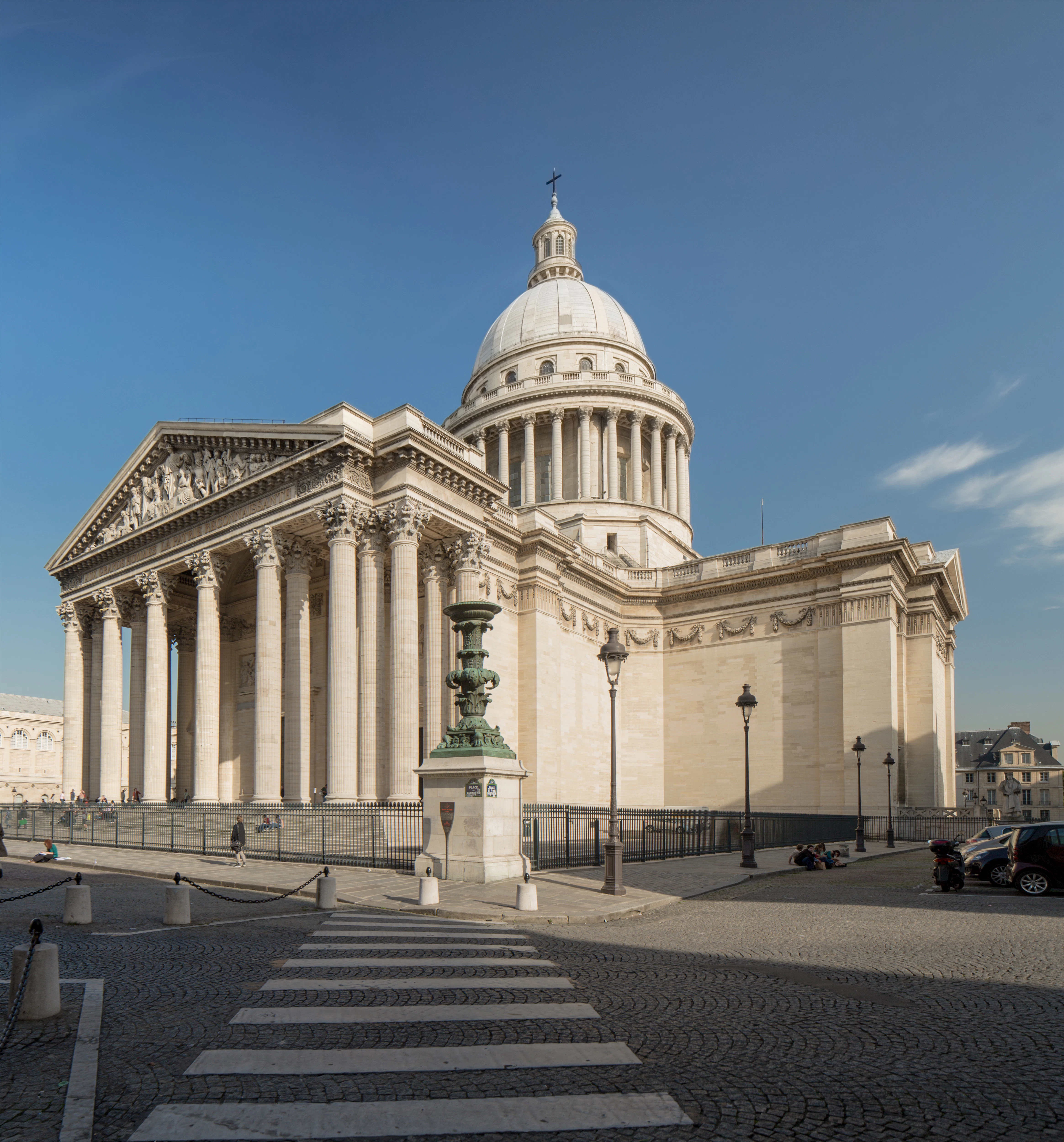
Visit the Panthéon, originally a church dedicated to St. Genevieve, now a secular mausoleum containing the remains of distinguished French citizens. Located in the Latin Quarter, it offers panoramic city views from its dome.
Visit Info & Tips
Nestled atop the Montagne Sainte-Geneviève in the Latin Quarter, the Panthéon stands as a monumental testament to France's enduring legacy and the great figures who have shaped its history. Originally conceived as a church dedicated to Saint Genevieve, its destiny was irrevocably altered during the French Revolution, transforming it into a mausoleum for the nation's most revered citizens. From its imposing neoclassical façade, crowned by a majestic dome, to the crypts below that house the remains of philosophers, writers, and scientists, the Panthéon invites visitors on a profound journey through the intellectual and historical heart of France. Stepping inside, the sheer scale and architectural grandeur of the Panthéon are immediately apparent. High vaulted ceilings, intricate sculptures, and the solemn grandeur of the space evoke a sense of reverence and wonder. The building itself is a masterpiece of Neoclassical architecture, with its prominent colonnaded portico and magnificent dome, often compared to St. Peter's Basilica in Rome or St. Paul's Cathedral in London. But beyond its architectural prowess, the Panthéon functions as a living archive of French thought and courage. It is here that the intellectual titans who illuminated the Age of Enlightenment and those who championed human rights and scientific discovery are honored, their legacies etched into the very fabric of the nation. Perhaps one of the most captivating features is Foucault's Pendulum, suspended from the dome, demonstrating the Earth's rotation in a mesmerizing, continuous motion. This scientific marvel, first exhibited here in 1851, provides a tangible link between the celestial and the earthly, mirroring the Panthéon's role as a bridge between the past and the present. The crypt, a labyrinthine space beneath the main floor, is where the true weight of history is felt. Here, in carefully arranged chambers, lie the final resting places of Victor Hugo, Marie Curie, Voltaire, Rousseau, Émile Zola, and many other luminaries. Each tomb tells a story, a chapter in the grand narrative of France, reminding us of the enduring impact of ideas and the individuals who dared to think differently. A visit to the Panthéon is not merely a tour of a historical building; it is a pilgrimage to the soul of France, an encounter with the spirits of innovation, revolution, and enlightenment.





Compare & Save
-
Pantheon Priority EntranceTickets
 TiqetsFrom€0
 -
Paris Latin Quarter Guided Walking Tour Pantheon EntryToursTiqetsFrom€0
-
Notre-Dame to Panthéon Guided Tour + Panthéon EntryTours
 HeadOutFrom€40
 -
Pantheon Basilica Of Saint DenisTicketsTiqetsFrom€0
-
Paris Latin Quarter Walking Tour + Panthéon EntryToursHeadOutFrom€67
Practical Info
About Panthéon
Commissioned by Louis XV in 1755, the Panthéon was originally intended as a church dedicated to Sainte Geneviève, the patron saint of Paris. Designed by architect Jacques-Germain Soufflot, the structure was a revolutionary blend of neoclassical majesty and Gothic lightness, inspired by the Pantheon in Rome and St Paul's Cathedral in London. Before the building was even finished, the French Revolution transformed its purpose. In 1791, the National Assembly decreed that the church should instead serve as a temple to liberty and a final resting place for the 'great men of the era of French liberty.' This shift from sacred to secular remains a defining characteristic of the site today. The exterior is dominated by a massive portico featuring 22 Corinthian columns and a pediment sculpted by David d'Angers. Inside, the sheer scale of the triple-shelled dome and the Greek-cross floor plan create an atmosphere of immense grandeur, further enhanced by monumental frescoes depicting the life of Saint Geneviève and the origins of the French monarchy. In the center of the nave hangs a replica of Foucault’s Pendulum, first installed in 1851 to provide a visible demonstration of the Earth's rotation. This scientific marvel serves as a reminder of the Panthéon’s role as a temple of reason and intellectual achievement. The crypt is the heart of the monument's commemorative mission. Organized into various galleries, it houses the tombs of icons such as Rousseau, Émile Zola, and Alexandre Dumas. Notably, Marie Curie was the first woman to be interred here based on her own merits, joining a roll call of national heroes that continues to grow with occasional new inductions.
What to See
Panthéon
The Crypt
Foucault's Pendulum
Neoclassical Architecture
The Nave and Dome
Mural Paintings
Panoramic Views (seasonal)
FAQ
History
<p>The story of the Panthéon is tightly interwoven with the turbulent history of France itself. Its origins trace back to an oath made by King Louis XV in 1744. Stricken with illness, he vowed to replace the ruined Abbey of Saint Genevieve with a magnificent church dedicated to Paris's patron saint should he recover. When he did, Jacques-Germain Soufflot, a prominent architect, was commissioned to design a grand Neoclassical edifice. Construction began in 1758, aiming for a structure that rivaled the great churches of Rome, but Soufflot did not live to see its completion.</p><p>The French Revolution dramatically altered the building's purpose. Just as it was nearing completion in 1791, the National Constituent Assembly decreed its transformation from a church into a mausoleum for the nation's great men, declaring, "Aux grands hommes la Patrie reconnaissante" (To great men, the grateful Homeland). Mirabeau was the first to be interred, setting a precedent for honoring those who contributed significantly to French society. Over the following centuries, the building oscillated between its ecclesiastical and civic roles, reflecting the political changes of France – a church under Napoleon, returned to a pantheon, then a church again, until its final designation as a secular mausoleum after the death of Victor Hugo in 1885.</p><p>One remarkable anecdote centers around Foucault's Pendulum. Léon Foucault first demonstrated his famous experiment here in 1851, proving the Earth's rotation to a captivated public. The original pendulum, a 67-meter wire with a 28-kilogram brass bob, was reinstalled in the Panthéon in 1995 (a replica hangs there today). This scientific exhibit perfectly encapsulates the spirit of enlightenment and intellectual curiosity that the Panthéon embodies, blending science, history, and architectural splendor under one magnificent dome. The Panthéon today stands as a powerful symbol of French republican values, a permanent tribute to the intellect, courage, and creativity that have shaped the nation.</p>
Save more with a Paris Pass that includes Panthéon
Bundle multiple top attractions, skip lines and pay less per ticket.
- Multi-attraction access
- Skip-the-line entry
- Better value than single tickets
- Free cancellation on most passes
Prices and inclusions verified with our partners Tiqets and Headout.
You may also like
Other attractions near Panthéon


🎟️ Book tickets for Panthéon
Book now ↗Book now ↗